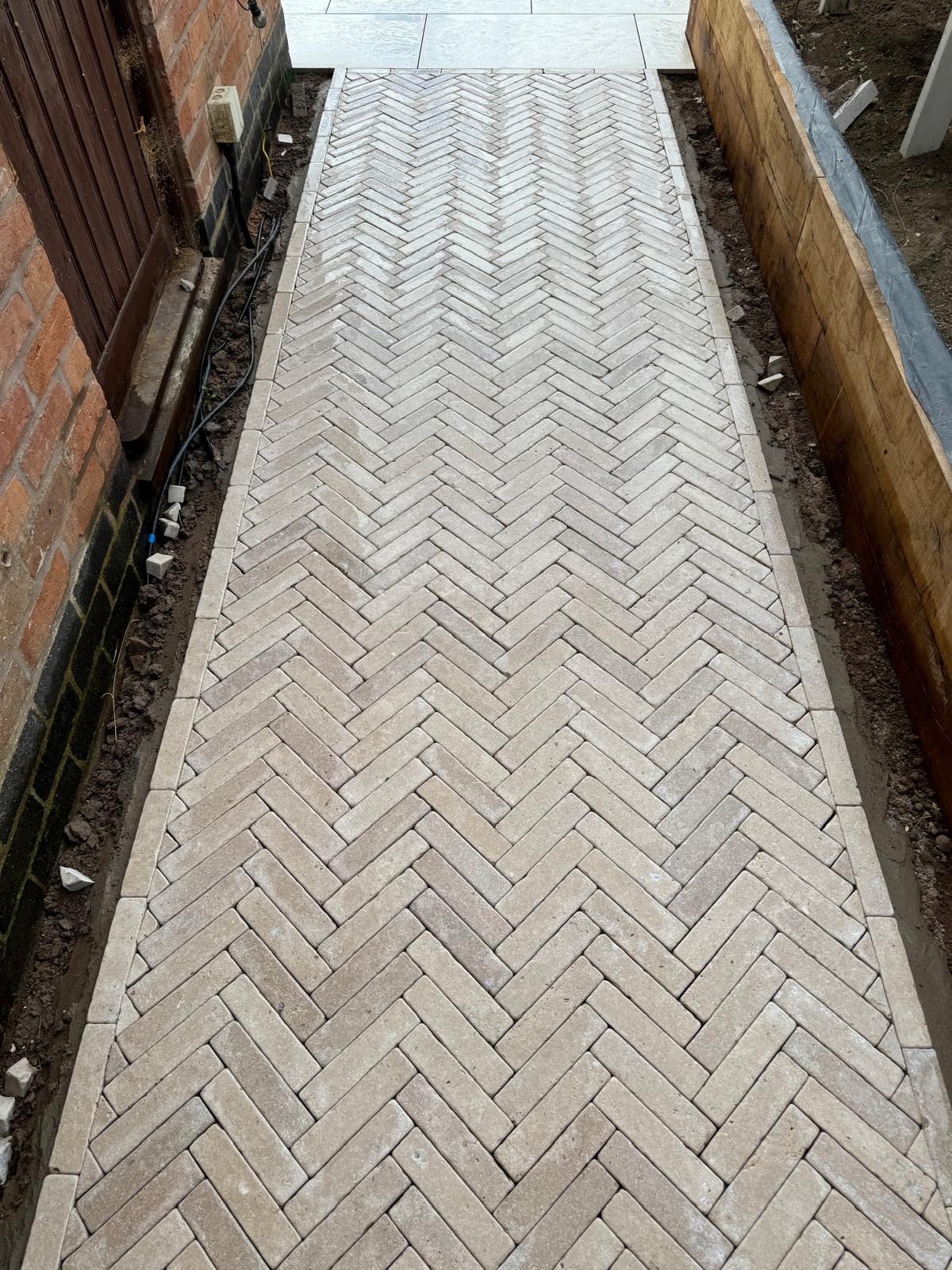
Takes vehicle loads
A properly excavated and compacted base is what stops ruts forming where you park.

Driveways, parking areas and paths laid on a compacted sub-base with haunched edge restraints, kiln-dried sand joints and drainage that actually works: fixed price, agreed dates.
Free quote within 48 hours · Fixed price on around 95% of jobs
10 years in the trade
5 of them running SOS Landscaping
Checkatrade approved
CHAS accredited
Fixed price on ~95% of jobs
Written before we start
Quotes within 48 hours
Same or next day locally
Team of two or more
Never a one-man job
Block paving is a flexible pavement: the blocks interlock and transfer load into the layers beneath, which is why the base is doing nearly all the work. A driveway needs excavation to a proper depth, a compacted sub-base in layers, a screeded laying course, blocks laid to a pattern, edges restrained and haunched in concrete, then the whole surface vibrated and the joints filled with kiln-dried sand.
We lay driveways, parking bays, garage aprons, paths and side returns, along with the kerbs, edging courses and drainage details that make them work. Falls are set so surface water runs to a drainage channel, permeable margin or soakaway instead of towards the house or off onto the pavement.
It is the right choice when a drive has sunk into ruts or potholes, when gravel is being spread down the road every time a car turns, when you need more off-street parking, or when a tired tarmac drive is letting down the front of the house. Blocks also suit awkward shapes because they cut cleanly and follow curves without wedge-shaped gaps.
The professional part is not laying the blocks; it is depth, compaction, edge restraint and drainage. Those four things decide whether the drive is still flat when the car has been parked on the same spot for five years.
Rutting and sinking is the classic symptom of an inadequate base. Wheel tracks appear where the car sits, the surface dips, water collects in the ruts, and each freeze makes it worse. No amount of re-sanding fixes it, because the problem is under the blocks, not between them.
The second failure is spreading. Without a haunched edge restraint, the outer courses migrate sideways under traffic. Joints open, sand washes out, weeds move in and blocks start to rock. From there the drive unravels progressively from the edges inwards.
Drainage is the third. A drive that sheds water towards the house delivers it to the wall, and one that drains onto the public footpath or road creates a nuisance and, in some cases, a compliance problem. Rebuilding a failed drive costs far more than building it properly, because the blocks usually have to come up and the base has to be excavated and rebuilt from scratch.
Guy checks levels, the existing surface, drainage, thresholds and access for machinery and spoil, and talks through block type, colour and pattern.
A written figure covering excavation, spoil removal, base, edgings, laying and jointing, usually same or next day locally, 48 hours at the latest.
Dig out to the depth the use demands, spoil taken away, and the formation checked before anything goes back in.
Sub-base laid and compacted in layers, edge restraints set and haunched in concrete, then a screeded laying course to the finished falls.
Blocks laid to pattern with clean cuts, the surface vibrated, joints filled with kiln-dried sand and vibrated again, site swept and cleared, then a walk-round with you.
A properly excavated and compacted base is what stops ruts forming where you park.
Haunched edge restraints and sand-filled joints keep the surface interlocked.
Falls set to a channel, soakaway or permeable margin: away from the house.
Blocks can be lifted and relaid for a service trench, then put back invisibly.
Curves, tapers and awkward corners work without ugly cuts.
A crisp drive with clean edging changes how the property reads from the road.
Standard concrete blocks are the most cost-effective and come in a wide range of colours; they are the pragmatic choice for larger drives. Permeable blocks with wider joints let water through the surface into the base, which is worth serious consideration on a front garden where surface water has nowhere else to go. Clay pavers hold their colour better than concrete over a long period and give a distinctly traditional look that suits older properties. Setts and cobbles are frequently used as a border or feature band within a block drive.
Patterns are not just decoration. Herringbone at 45 or 90 degrees gives the strongest interlock and is the right choice for vehicle areas; stretcher bond looks fine on paths but is weaker under turning traffic. Basketweave suits decorative areas. A contrasting soldier course around the perimeter tidies the edge and hides the cuts.
Depth is chosen for the load: a footpath and a drive that takes a family car do not get the same build-up, and an area where a van turns needs more again. Sub-base material is laid and compacted in layers so compaction reaches the bottom of each one, and the formation is checked before any of it goes down.
Edge restraints go in before the field of blocks, set to line and level and haunched in concrete, because they are what resists the sideways spread that destroys unrestrained paving. The laying course is then screeded to the finished falls, blocks are laid off the string lines, and cuts are made properly at the edges rather than filled.
Finally the surface is vibrated, kiln-dried sand is brushed into the joints and vibrated in again so the blocks interlock. Drainage is designed in from the start: falls to a linear channel, a permeable margin, a soakaway or a gravel strip, so water does not run towards the house or off onto the public highway. Where a drive crosses a threshold or meets a garage, levels are set so water is kept out of the building.
Driveways and parking areas are the most common project, often widening an existing drive to take a second car or replacing a rutted tarmac surface. Garage aprons and turning areas take the heaviest wear and are where base depth matters most. Front paths, side returns, bin stores and gateway thresholds all benefit from blocks because they are hard-wearing and easy to lift and relay if a service is ever dug up.
In gardens, block paving is used for utility paths, greenhouse and shed surrounds and areas where a wheelbarrow or mower runs regularly. It is often combined with a sett border or a paved patio elsewhere in the garden so the materials talk to each other.
For commercial premises the same construction applies with a deeper base for heavier vehicles and a stronger emphasis on drainage design and marked-out parking. In all cases, the honest advice is that on a drive, money is better spent under the surface than on the blocks themselves.
Based at 24 Common Lane, Kenilworth. Local work gets priced fastest: often the same day. Just outside these areas? It is still worth a call.
The main drivers are area, excavation depth, how much spoil has to be taken away, drainage requirements and access. Guy quotes after seeing the site, and around 95% of jobs are fixed-price in writing. Blocks are bought by you, so material costs are fully transparent.
A typical domestic drive is a matter of days rather than weeks, with excavation and base taking longer than the block laying. You get a start date and a realistic duration with the quote.
Once the surface is vibrated, jointed and the edge haunching has cured, yes. Guy will tell you on the day exactly when to drive on it.
Front gardens paved with a non-permeable surface may need permission unless water is directed to a permeable area or soakaway. Permeable blocks or a drainage detail usually solve it, and Guy will flag it at the quote so you can check with the council.
Weeds germinate in the surface of the joint sand rather than growing up from below, so keeping the joints properly filled and giving the drive an occasional wash keeps growth minimal.
Not if the base is built for vehicle loads. Rutting is almost always a base failure, which is why excavation depth and layered compaction are not areas we cut back on.
Often yes: blocks can be lifted and relaid, and extensions can be tied in. Matching an older, weathered block exactly is not always possible, so sometimes a deliberate border or band looks better than a near-match.
We stand behind our work. If anything ever needs attention after we have finished, give Guy a call and he will come back and put it right.
Smaller jobs are paid on completion. Larger jobs, which most drives are, are staged: one payment at the end of the first week and the balance on completion.
Yes. Kenilworth, Leamington, Warwick, Coventry, Balsall Common, Chadwick End, Knowle, Earlsdon and Leek Wootton are all areas we cover.
Tell Guy the rough size of the drive and what is there now. You will have a free fixed-price quote covering excavation, base, edgings and laying, usually within 48 hours.
Prefer to talk it through?
07466 254430finchfinishings@gmail.com
Hours: 7:00am – 6:00pm
Free quotes · Fixed prices · Checkatrade approved · CHAS accredited