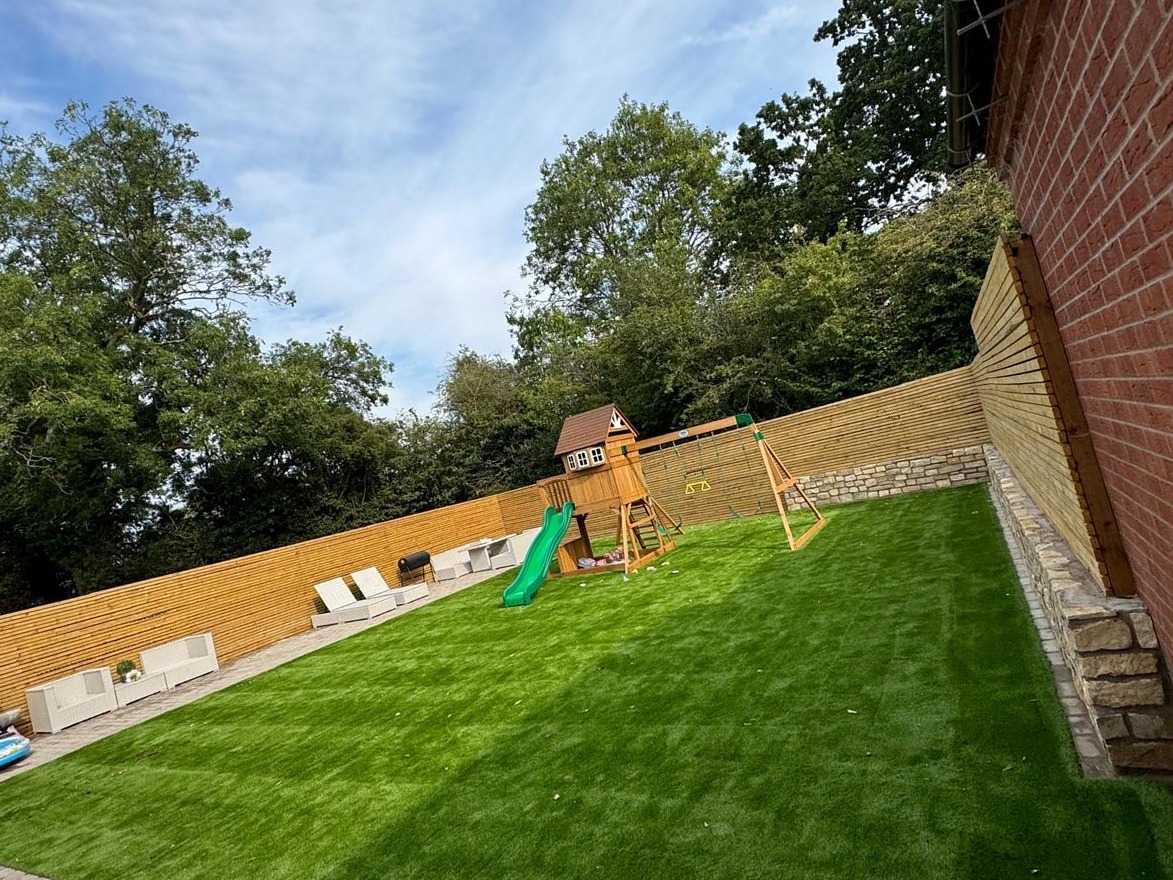
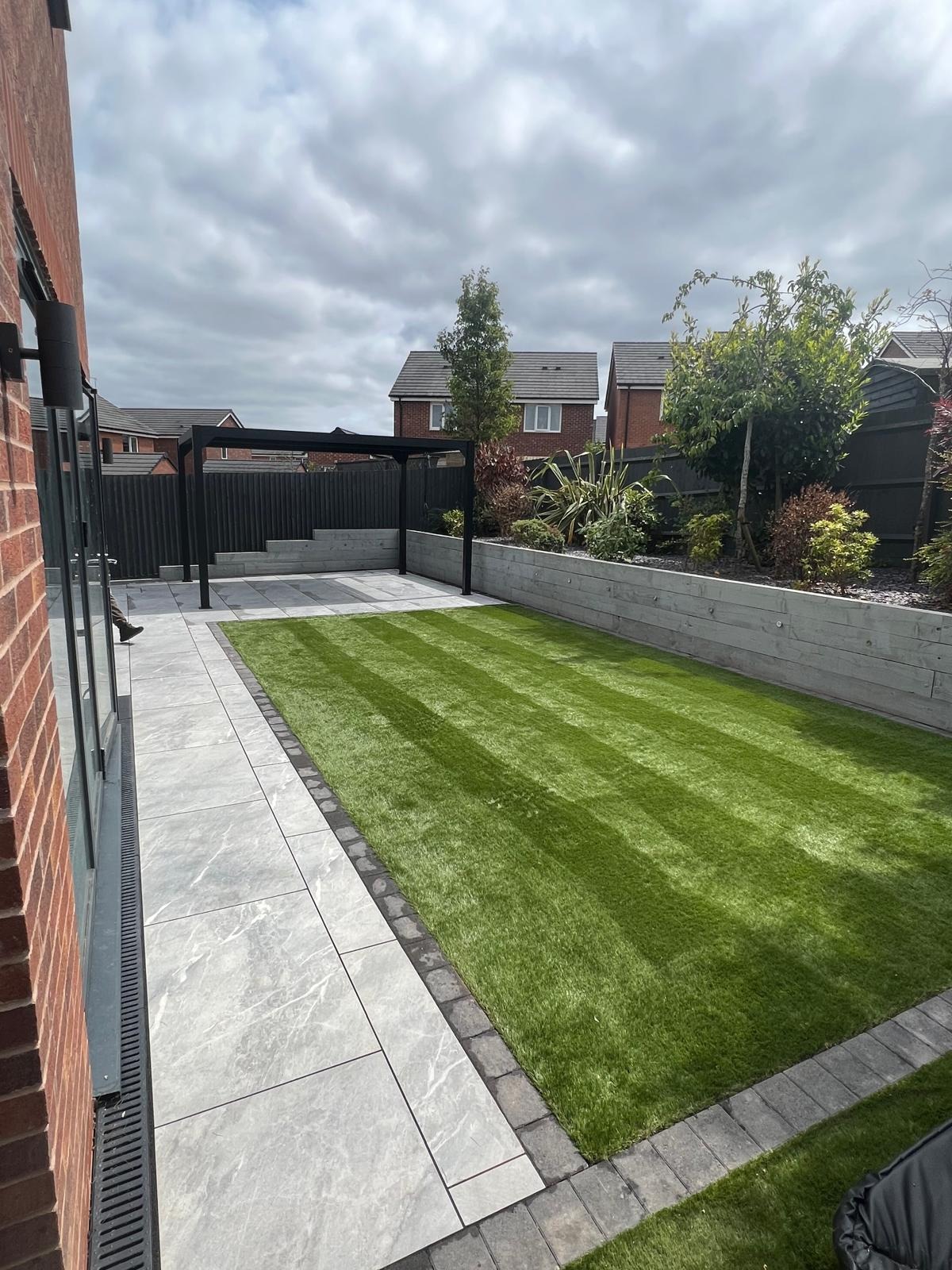
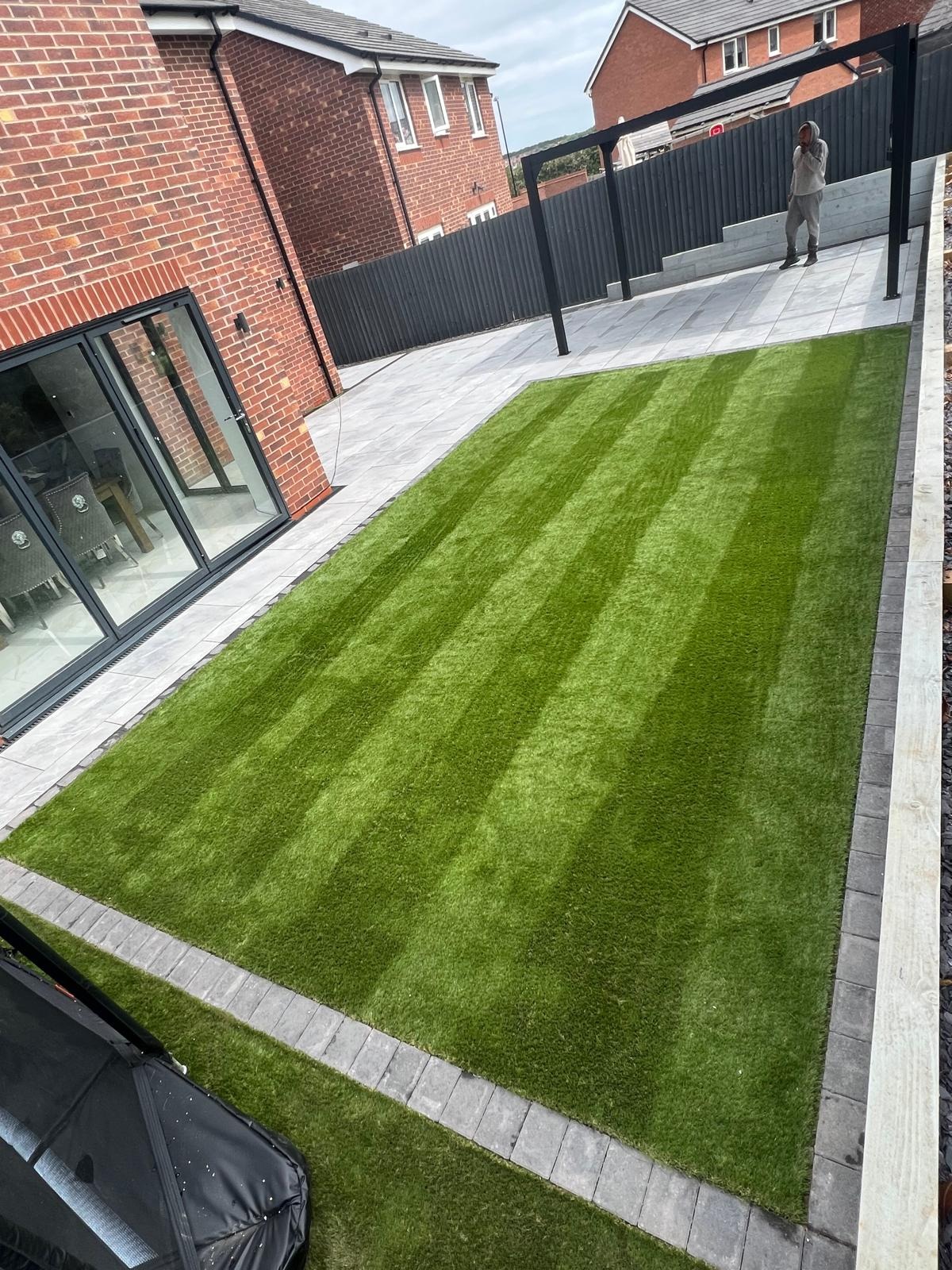
Green all year
No bare patches, no mud in February, no waiting for a lawn to recover.
A green, usable lawn all year with no mowing: installed on a compacted, free-draining base with fixed edges and joins you cannot see, not rolled out over old turf.
Free quote within 48 hours · Fixed price on around 95% of jobs
10 years in the trade
5 of them running SOS Landscaping
Checkatrade approved
CHAS accredited
Fixed price on ~95% of jobs
Agreed in writing up front
Quotes within 48 hours
Same or next day locally
Team of two or more
Rolls handled and joined properly
Artificial grass is a groundworks job with a surface layer at the end. The existing lawn or surface is excavated, a compacted free-draining sub-base is built, a fine laying course is screeded to level, edges are formed and fixed, then the grass is laid, allowed to relax, joined, secured and brushed up. Done that way it stays flat, drains through and looks like a lawn. Rolled out over old turf it will ripple, sink in patches and hold water.
We install artificial lawns as complete replacements for grass, in small courtyards and side returns where nothing will grow, on roof-level and balcony areas, around pools and hot tubs, and as dog runs and play areas that need to survive daily use. Joins are set out so they fall where they will not be seen, and the pile direction is kept consistent across the whole lawn.
It suits gardens that are too shaded, too small or too heavily used for real grass to survive, households that want the space usable all winter rather than a mud bath, and anyone who would rather not spend summer weekends mowing. It is also the practical answer for rental properties where nobody is going to maintain a lawn.
The value of a professional installation is entirely in the base and the edges. Those are what stop ripples, dips, lifting perimeters and standing water, and they are invisible once the grass is down, which is why they are the first thing cheap installations skip.
Laid on unprepared ground, artificial grass follows every hollow and hump beneath it, and soft spots turn into visible dips as soon as it starts being walked on. Because the backing is a barrier, any water that cannot drain through the base sits under the grass, staying wet and smelling: particularly where a dog uses it.
Edges are the other common failure. Grass not fixed to a proper perimeter starts to lift and curl, catching feet and mower wheels and letting weeds in around the boundary. Joins made carelessly, or with the pile running in opposite directions, show up as a permanent stripe across the lawn in certain light.
The costs escalate because you cannot really rescue a bad installation. Once the grass has been cut to a shape, lifting it to build the base properly usually means new grass as well as new groundwork, so the cheap install ends up being the expensive one.
Guy assesses the ground, how water currently behaves, the shape of the area, access and where joins will need to fall, and talks through pile options with you.
A written figure covering excavation, spoil removal, base, edging and installation, usually the same or next day locally and within 48 hours at the latest.
Existing lawn or surface stripped out to depth, roots and debris cleared, and spoil taken away so the base can be built on sound formation.
Compacted free-draining sub-base built, perimeter edging formed and fixed, then a fine laying course screeded to level and consolidated.
Grass laid and left to relax, cut to shape, joined so the seams are invisible, secured at the perimeter, then brushed up and the site cleared. Anything that needs attention later, one call to Guy.
No bare patches, no mud in February, no waiting for a lawn to recover.
Time back every week and no mower, strimmer or fertiliser to buy.
A free-draining base means children and dogs can be out on it hours after rain.
Compacted base and screeded laying course prevent the ripples and dips that give cheap installs away.
Deep shade, tiny courtyards, side returns and heavily used dog runs.
An occasional brush and rinse keeps the pile upright and the surface clean.
Pile height, density and colour blend all change how convincing the lawn looks. Shorter, denser piles handle traffic best and stay upright, which makes them the sensible choice for family gardens and dog runs. Longer piles look luxurious in a photograph but flatten in walkways and need more brushing. A blend of green tones with a brown thatch layer reads far more naturally than a single bright green.
Backing and drainage specification matter more than most people realise. Fully permeable backings are essential where pets will use the lawn, because urine has to drain through the surface rather than sit on it. Guy will talk through pile options against how the lawn will actually be used, and since materials are bought by you, there is no incentive to push you up a range.
Excavation depth is set by the build-up needed rather than convenience: enough for a compacted sub-base plus a fine laying course, so the finished grass level sits flush with adjoining paving, thresholds or edging rather than proud of it. Formation is cleared of roots and debris; anything that will decompose under the grass comes out.
The sub-base is compacted in layers, then a fine laying course is screeded and consolidated to a smooth, even surface; this is the layer that determines whether the finished lawn feels flat underfoot. A membrane is used to suppress weed growth from below while allowing water through, and the perimeter edging is fixed to give something solid to secure the grass to.
Grass is rolled out and left to relax so creases drop out before it is cut. Joins are set out to fall in inconspicuous places, made with the pile running the same way on both sides, and finished so the seam disappears. The perimeter is secured, sand dressing is applied where the specification calls for it, and the whole lawn is brushed against the pile to stand the fibres up. We stand behind our work, if anything ever needs attention, call Guy and he will come back.
Small, enclosed gardens are the strongest case: shaded by fences and buildings, walked on constantly, and never given time to recover. Side returns, courtyards, front gardens and the strip between a patio and a fence rarely support decent grass, and artificial turf keeps them green with no maintenance.
Dog owners are the second big group. With a permeable backing, a free-draining base and an occasional rinse, a dog run stays usable rather than turning to mud and worn patches. Play areas, trampoline surrounds, hot tub and pool surrounds and roof terraces all work well for similar reasons.
It is not the answer everywhere. Where a real lawn can thrive and you want wildlife, planting interest and a natural surface, turfing is the better job and Guy will say so. Artificial grass is often combined with paving, sleeper edging or a path so the lawn has a clean, fixed perimeter on every side, which is exactly what makes it last.
Based at 24 Common Lane, Kenilworth. Local work gets priced fastest: often the same day. Just outside these areas? It is still worth a call.
See all services, read about Guy Finch, our Kenilworth landscaper or check the landscaping areas covered in Warwickshire.
Cost depends on the area, how much excavation and spoil removal is needed, the edging detail and access. Guy quotes after visiting, and around 95% of jobs are fixed-price. The grass itself is bought by you, so material cost is completely transparent.
Most domestic lawns are completed within a few days, with the groundwork taking longer than laying the grass. A realistic duration comes with the quote.
A well-specified lawn on a properly built base has a long service life; wear shows first in walkways and at seams, which is why pile choice and join placement are decided at the start rather than on the day.
Yes, with a permeable backing and a free-draining base so liquid passes through rather than sitting on the surface. A periodic rinse keeps it fresh. It is one of the most common reasons people ask for it.
It should, and that is what the base is for. A compacted free-draining sub-base and a permeable membrane and backing let water through; a lawn laid on clay or over old turf is what puddles.
No. The old grass decomposes and the surface dips unevenly. The lawn is stripped out and a proper base is built, which is the difference between an installation that stays flat and one that ripples.
It does warm up in strong direct sun more than real grass. A rinse cools it quickly, and it is worth bearing in mind for a fully south-facing garden with no shade.
An occasional brush to keep the pile upright, removal of leaves and debris, and a rinse when needed. No mowing, feeding, watering or scarifying.
Not when they are set out in inconspicuous places with the pile running the same way on both sides and finished properly. Visible seams are an installation fault, not a property of the product.
Yes. Kenilworth, Leamington, Warwick, Coventry, Balsall Common, Chadwick End, Knowle, Earlsdon and Leek Wootton are all areas we cover.
Tell Guy the size of the area and how it will be used: kids, dogs or just a tidy space. You will have a free quote back, usually within 48 hours.
Prefer to talk it through?
07466 254430finchfinishings@gmail.com
Hours: 7:00am – 6:00pm
Free quotes · Fixed prices · Checkatrade approved · CHAS accredited